England’s fixtures this summer include international cricket matches with New Zealand (3 Tests), India (5 T20 and 3 ODIs), Pakistan (3 Tests) and Sri Lanka (3T20 and 3 ODI). None of the visitors are scheduled to visit Oxford University’s Parks cricket ground or Cambridge University’s Fenner’s, whereas a few years back, international teams were regular visitors to at least one of these two university grounds.
Similarly, now, the English cricket season doesn’t commence with the county teams playing with the university sides as a custom. In fact, both Oxford University and Cambridge University have lost their first-class cricket status in the last few years, their grounds no longer play first class cricket matches and Lord’s has also removed the customary match between university sides from its schedule.
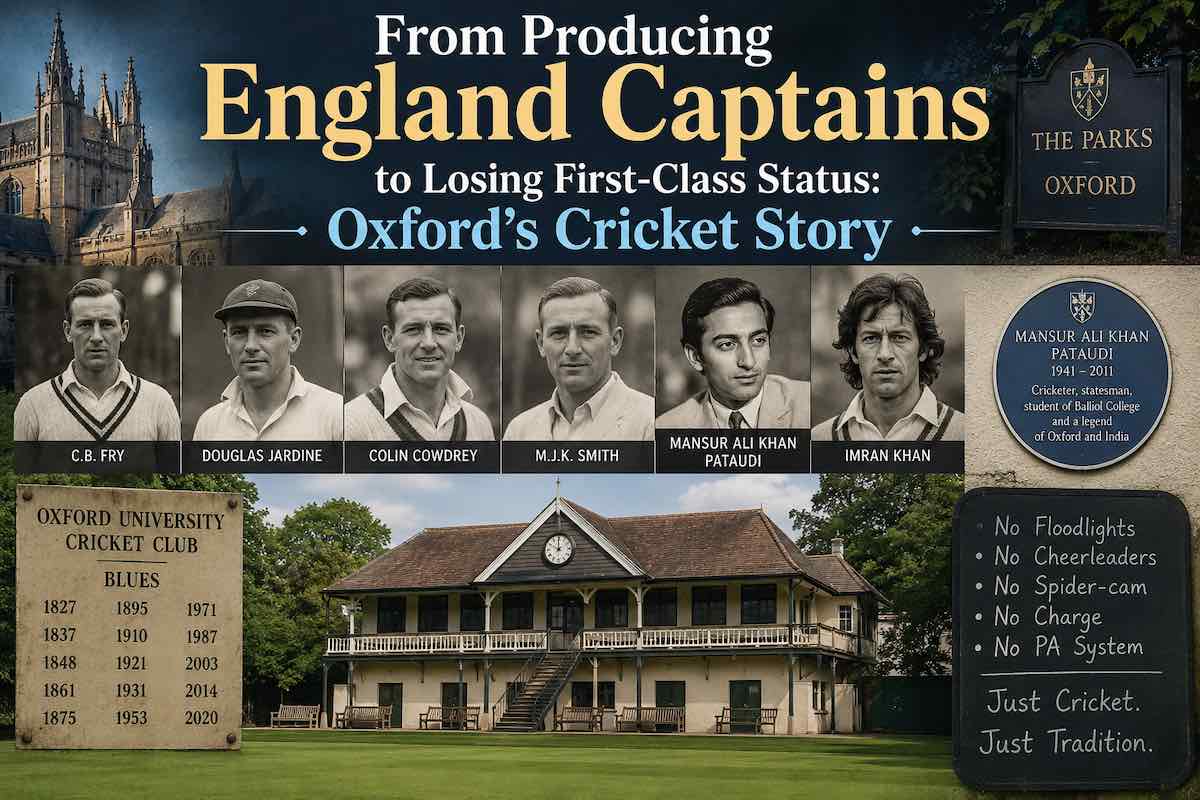
The present generation of cricket lovers know that the way to Team India goes through the IPL or to the England team, through The Hundred, but it was not like that until a few years back. If Oxford University means an amalgamation of 43 colleges, the oldest English-speaking university in the world, where teaching dates to 1096, this university was the stepping stone to playing higher cricket. In England, they used to say that only an Oxford or Cambridge student qualifies to be the England captain. Before the First World War, every other England captain seemed to come from Oxford. That is the way it was, the prime ministers and England cricket captains came from Oxford: Lord Harris, Plum Warner, Reggie Foster, CB Fry, Douglas Jardine, Colin Cowdrey and MJK Smith to name a few.
George Abel was also a student here. He holds the record for scoring the first double-hundred in the Ranji Trophy, for Northern India. He is also given credit for designing the Lawrence Gardens cricket ground in Lahore (in undivided India) and the pavilion here is almost a replica of the Parks. It is still one of the most beautiful cricket grounds in the world, surrounded by many trees.
The university alumni include both Nawabs of Pataudi and Imran Khan (he scored a century in each inning here, against Nottinghamshire). The 1931 Oxford side included three South African Test players, current and future. Mansur Ali Khan Pataudi scored a hundred in each inning against the reigning county champions, Yorkshire, at the Parks in 1961. A few days after that, he lost the sight of an eye.
In 2012, a plaque in the honour of Mansur Ali Khan Pataudi was unveiled at the Oxford University pavilion in the presence of his family, installed on the wall of the historic pavilion in the Parks. Andrew Thomas, head of development (sport) at the University, said: ‘We are delighted to honour a legend in Oxford and India by installing a permanent plaque in the University's historic cricket pavilion in the Parks.’ Mansur Ali Khan Pataudi studied Arabic and French at Balliol College and famously scored centuries in three consecutive first-class matches for the Blues.
There is a bench named after Martin Donnelly, who scored 2,287 first-class runs for the New Zealand tourists of 1949, including a double century against England at Lord’s, after his studies at Oxford.
The streets of Oxford feel like history. The mathematician, Dr Lewis of the Duckworth-Lewis method, was a lecturer at Oxford, often watched matches there. His name is written on a bench where he used to sit. Colin Cowdrey, the former England captain, has a plaque with the citation, ‘Remembered by his Oxford friends.’ The locals say, ‘He came here, but couldn’t finish his PhD because he played too much cricket. He just played and played and played.’
Imran Khan, former PM of Pakistan and cricket legend, studied Philosophy, Politics, and Economics (PPE) at Klebe College, Oxford, from 1972 to 1975. While at Oxford, he captained the university's cricket team. In 2024, Imran had even attempted to become the chancellor of Oxford University from jail, but his bid was rejected. He is an honorary fellow of Klebe College. An almost unknown fact is that prior to his political career, he was the Chancellor of Bradford University from 2005 to 2014.
The old pavilion in the Parks has not changed even a bit. The wooden boards inside list the Blues of every season back to 1827. The Parks’ Cricket Pavilion, completed in 1881, was designed by Sir Thomas Jackson, one of the most distinguished architects of his generation.