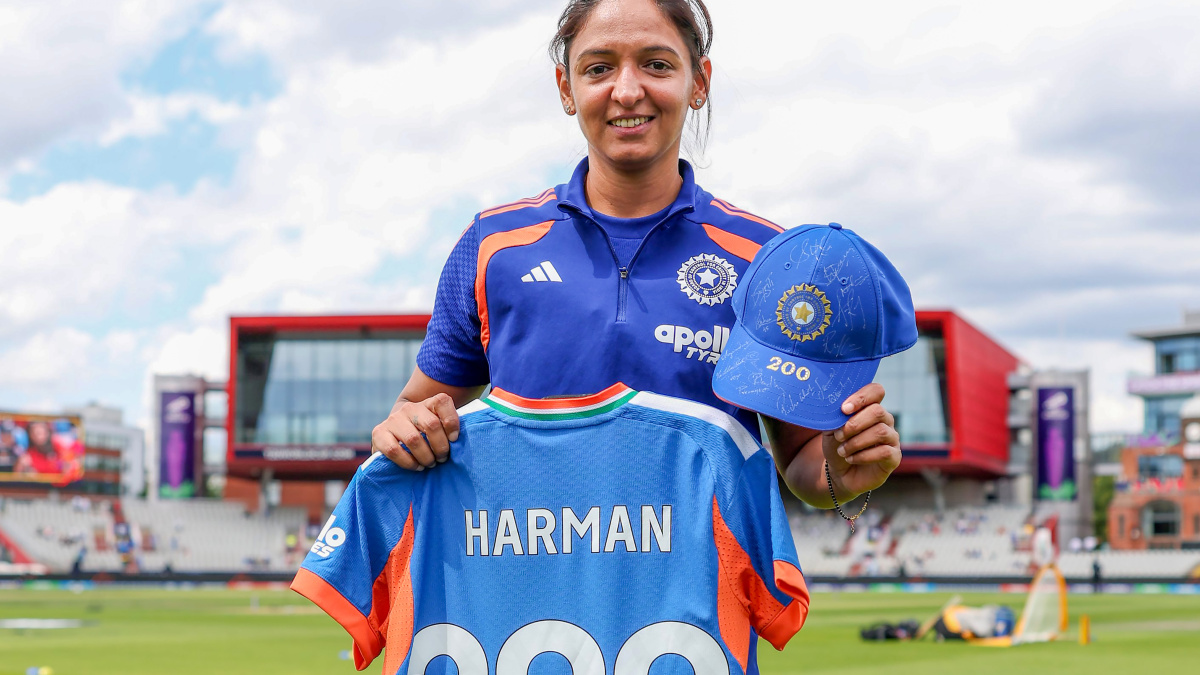
T20 World Cup: Former India pacer Niranjana Nagarajan has backed Harmanpreet Kaur to remain as the T20I captain despite another group stage exit in the 2026 Women’s T20 World Cup, adding that she hasn’t underperformed as a skipper and instead pointed to a structural need for middle-order power hitters in the shortest format.
The debate surrounding India’s shortest-format leadership had intensified following the Indian team failing to enter Women’s T20 World Cup semi-finals for the second straight time. It happened just a fortnight before India’s historic Test triumph over England at Lord’s. Harmanpreet will turn 39 by the time the 2028 Women’s T20 World Cup arrives, with many advocating for a leadership transition to happen.
“I think Harman is doing a good job. I don’t think one World Cup loss should bother so much. This is the problem – one loss and everything comes up. The same Harman, who won the ODI World Cup, why not just back her for one off tournament? Give her that space. At the end of the day, they are all going through the same thing. We are all humans and make mistakes.
“But I don’t think she has underperformed. She has stood up as a captain for India over the last 7-8 years. She has never underperformed as a captain. Even against Australia, she was the one who stood up. The captaincy is not affecting her. Even the coach is quite happy with her captaincy.
“It is up to the selector to decide whether they should change the captain or not. But in my opinion, it is not necessary now. The team has done and is doing well. The team is producing historic results under her captaincy. So, I don’t think it is needed,” Niranjana told IANS in an exclusive conversation.
While India’s ODI and Test match game under Kaur and head coach Amol Muzumdar appears settled, their recurring stumbles in T20Is have drawn scrutiny. Nagarajan rejected the notion that the team has a mental block or is behind the pace of modern-day T20 cricket.
“No, I don’t think so. See, in my perspective, I think we need a couple of more big hitters in the middle order. I don’t want to be very critical because I still back this team. But probably when you say you need to make an impact on the T20 aspect globally, we need a couple of more power hitters in the middle who can clear the boundaries between the 7th and the 15th over, where Harman can get a little more cushioning and that pressure, it should reduce.
“When she comes out to bat, probably it is always 60/2 in 7, 8 overs or 10 overs. She is not able to take the risks immediately because we are losing wickets at a stretch. So, there we need a player who probably can support and release the pressure off Harman. At the same time, they also score runs with big shots. So, probably they say like the 15th or the 16th over or maybe the 13th over itself – Harman can then start going.
“Probably 150 can become 180 or maybe 180 can become 195 or something like that. So, maybe in the middle order, a couple of more power hitters can make a difference. It is just my humble opinion. I think they are working on it and probably it will happen very soon. We definitely have plenty of talent,” she added.
India’s T20 World Cup campaign was also hindered by critical pre-tournament injuries to emerging all-rounders Amanjot Kaur and Kashvee Gautam, as well as Shreyanka Patil ruled out mid-way due to ankle injury, which disrupted the side’s overall balance. It was clearly evident from India fielding a different bowling combination in each of the five matches, changing both its seam attack and new‑ball pairing every time.
The seamers struggled, as Renuka Singh Thakur, Kranti Gaud, Arundhati Reddy and Nandni Sharma shared only five wickets between themselves. “There are quite a number of fast-bowlers, definitely. But I still would say that I like Renuka as a fast-bowler, especially in swinging conditions and Kranti too. Just that Renuka’s experience could have been utilised in a better way.
“Yes, the absence of all-rounders, definitely it was hard because they give us the kind of balance that is required to set up an eleven and we couldn’t find a settled eleven for the games. But again, that comes to the call of the management and the selectors. Probably for the next campaign or the next roadmap for the World Cup, we will see a better combination,” added Niranjana.
With still a lot of cricket ahead, including the Women’s Asia Cup, the Asian Games, home series against Zimbabwe, and a multi-format tour of South Africa, Niranjana urged the need to prioritise the physical management of its fast bowlers through domestic structures and elite camps.
“I think the outlook should be that the fast bowlers first should be preserved and taken care of because a lot of tournaments which are coming up will be requiring the services of fast bowlers. I think the BCCI is doing a wonderful job in conducting camps with the CoE (Centre of Excellence).
“The process is going on really well. The core team will anyway remain the same. The rest of it will be decided on the domestic performances because the domestic season is going to start as such in October. A lot depends on that as well and the preparation has already started and it’s just an ongoing process,” she concluded.
Article Source: IANS