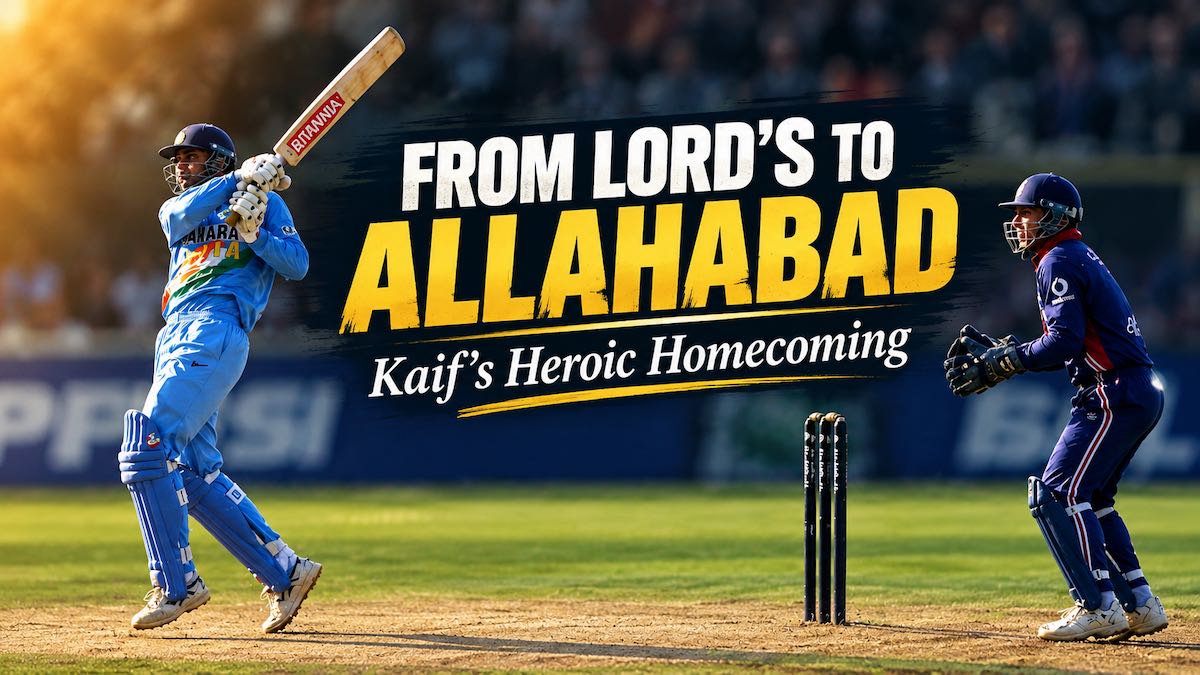
There are sporting victories that remain memorable for what happened on the field. And then there are those that become part of a city’s folklore because of what happens when the hero returns home.
For Mohammad Kaif, the greatest moment of his cricket career came at Lord’s on July 13, 2002. But the moment that perhaps stayed with him most vividly happened thousands of kilometres away, in Allahabad.
India had chased down 326 against England in the NatWest Trophy final, recovering from 146 for five to win by two wickets. At the centre of that extraordinary recovery was the 21-year-old Kaif, unbeaten on 87, sharing a match-winning 121-run partnership with Yuvraj Singh.
Lord’s had made Kaif a national hero. Allahabad turned him into something he had never imagined. “I was a shy person, but I felt like Amitabh Bachchan that day,” Kaif later recalled.
The comparison was not accidental. As a child growing up in Allahabad, Kaif had watched Amitabh Bachchan arrive in an open jeep after winning an election in his hometown. Years later, after producing one of the most celebrated innings in Indian cricket history, Kaif found himself travelling through the same kind of crowd-filled streets of Allahabad, standing in an open jeep while thousands came out to celebrate him.
But the comedy of his homecoming had actually begun on the night of the Lord’s final itself.
When India collapsed to 146 for five, Kaif’s father Mohammad Tarif and elder brother Saif had lost hope. Expecting a heavy defeat, they locked up the house and went to a local Allahabad cinema hall to watch Shah Rukh Khan’s Devdas.
While they sat in the darkness of the theatre, Kaif was busy producing the innings of his life in London.
When Tarif and Saif emerged from the cinema, they were stunned. Allahabad’s streets were suddenly alive with firecrackers, celebrations and chanting crowds. Confused, they rushed home — only to find a massive gathering outside their gate. They had to knock on their own door and look around to confirm that it was indeed their boy, “Honey”, Kaif’s pet name, who had just won the match for India.
The family had gone to the cinema expecting to return after an Indian defeat. Instead, they came back to discover that their son had become the hero of the city.
At Lord’s, England had made 325, with captain Nasser Hussain scoring 115. India began well but slipped from 106 without loss to 146 for five. Then came Yuvraj and Kaif, who added 121 and transformed the chase. After Yuvraj fell, Kaif stayed until the end, guiding India home with the lower order.
India needed six runs from seven balls and then two from the final over. Kaif and Zaheer Khan eventually scrambled the winning runs, with an overthrow completing one of the most dramatic finishes in Indian ODI history. Kaif remained unbeaten on 87 from 75 balls and was named Player of the Match.
The celebrations at Lord’s were spectacular. But what awaited Kaif in Allahabad was something altogether different.
When he returned home, the streets around his neighbourhood were packed. People poured out to see their local hero. An open-jeep procession covering only about five to six kilometres took nearly three to four hours because of the crowds. There were garlands, sweets, cheers and people lining the roads.
There was also something almost poetic about the way Allahabad celebrated him.
As a boy, Kaif had watched Amitabh Bachchan being treated like a larger-than-life figure during an open-jeep procession. Now, after one unforgettable evening at Lord’s, he was experiencing something similar himself.
That is why his description — “I felt like Amitabh Bachchan” — captures more than the scale of the celebration. It captures the journey of a boy from Allahabad who had grown up watching heroes from a distance and suddenly found himself being treated as one.
For Allahabad, however, the significance was more personal. The city had produced many sportspersons, but Kaif became its ultimate cricketing hero. He would go on to captain Uttar Pradesh to their maiden Ranji Trophy title in 2006, defeating Bengal in a memorable final, and later play 13 Tests, 125 ODIs and 177 first-class matches.
View this post on Instagram
A post shared by cricketnmore (@cricketnmore)