Phil Henderson has died at the age of 77. His name is unlikely to appear in cricket reference books or on cricket portals, which is why his death went largely unnoticed. Yet it has brought back the memory of one of the strangest and darkest incidents in cricket history.
Phil was the last surviving son of Captain Arthur Henderson, an Australian army officer and keen amateur cricketer who was shot dead while fielding during a match in Adelaide in 1952. It remains the only known case of a cricketer being murdered while playing the game.
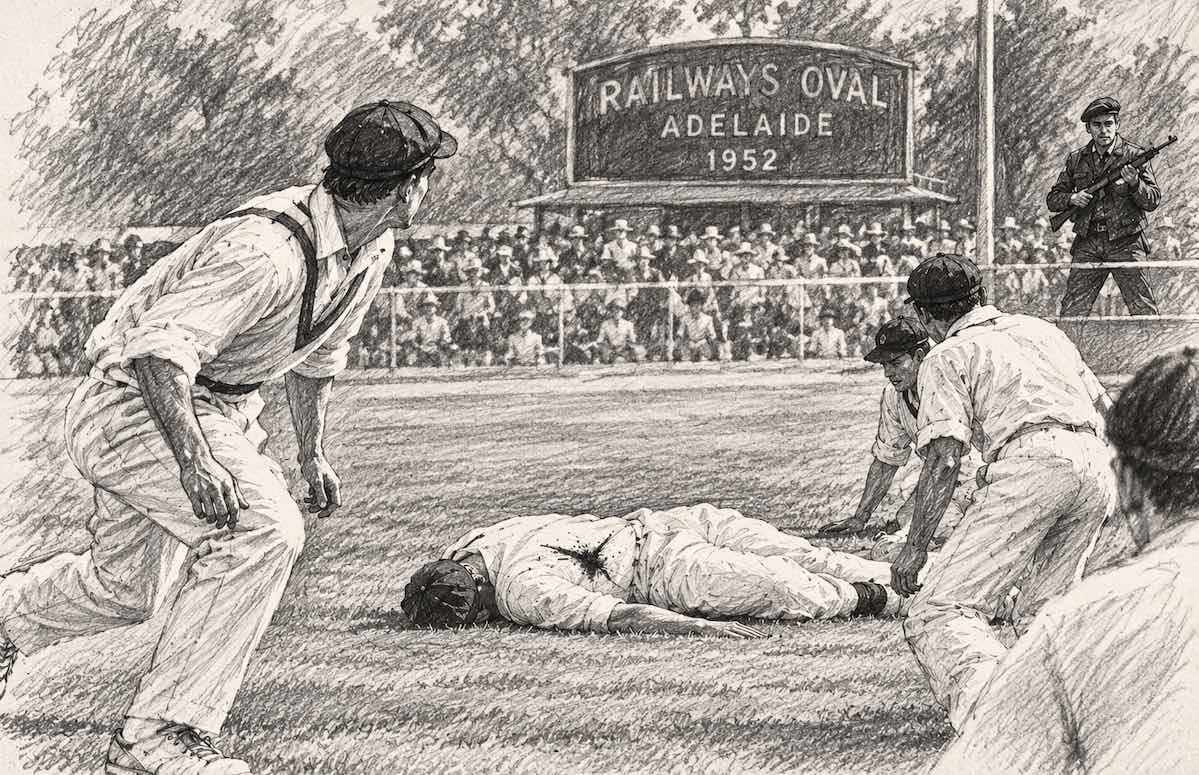
The setting was Railways Oval in Adelaide, now known as Karen Rolton Oval. It was February 13, 1952, and the annual South Australian Country Week tournament was under way.
Henderson, 33, was fielding at cover point for Upper North against Southeast. He was an army captain stationed at the newly established Woomera rocket range, a married man with three young sons and a popular sportsman. This was his second and the last match for his side.
About half an hour into the game, opening bowler Sergeant Les Patroney heard a rifle shot. A bullet struck Henderson from behind as he stood at cover point. It passed through his body and hit his heart, killing him almost instantly.
Before the players could understand what had happened, another shot rang out. The gunman was standing near the boundary. Panic spread across the ground as players ran towards the dressing room.
Another member of Upper North, Ron Reed, was wounded in the arm or shoulder. More shots followed, one hitting a seat while others narrowly missed people. The gunman was carrying a .303 rifle. He was 24-year-old Lebanese migrant Elias Gaha.
There had been warning signs. Gaha had suffered serious mental health problems and had previously been admitted to psychiatric hospitals in Victoria. By January 1952, he was in Adelaide carrying an ex-Army rifle which he believed he needed for protection. On the morning of the shooting also he went to the Commonwealth Immigration Department and complained that the government was conspiring against him. Within an hour, he was at the cricket ground.
After shooting Henderson, Gaha continued firing until Detective John Giles intervened. After several tense minutes, Giles and other officers managed to overpower and disarm him. Gaha was arrested and charged with murder.
The case never became an ordinary murder trial. His mental condition was central to the proceedings, and he was certified insane and committed to a psychiatric institution. He was later deported to Lebanon.
Arthur left behind his wife Joyce and three sons—John, Mick and Phil. Phil was not yet three when his father was killed. Arthur was given a military funeral at Centennial Park, while the Country Week competition was suspended before eventually resuming.
Phil grew up, joined the Army, married Annette and built a career with 3M. As an adult, he reconstructed his father's life, collecting photographs and documents and building a family tree. He also helped preserve Arthur's story through the Virtual War Memorial Australia.
He discovered that his father had been born in Bairnsdale, Victoria, in 1918, attended Xavier College, served during the Second World War and later became an army officer. At Woomera, he became vice-president of the local cricket association.
Cricket had been an important part of Arthur's life. It was also where his life ended.
The official record is stark: his cause of death was a bullet wound to the heart. His place of death was simply a cricket field. Because Arthur Francis Henderson was a career military officer and an amateur country-week cricketer rather than a first-class or international player, he does not have an official individual obituary in the Wisden Cricketers' Almanack. Also, as Captain Henderson's high-level involvement was strictly limited to local regional associations, his death bypassed the almanac's formal recording.
More than 70 years later, the image remains haunting, players in white, a summer morning, an ordinary cricket match, and suddenly a body lying on the grass while an armed man stood outside the boundary.