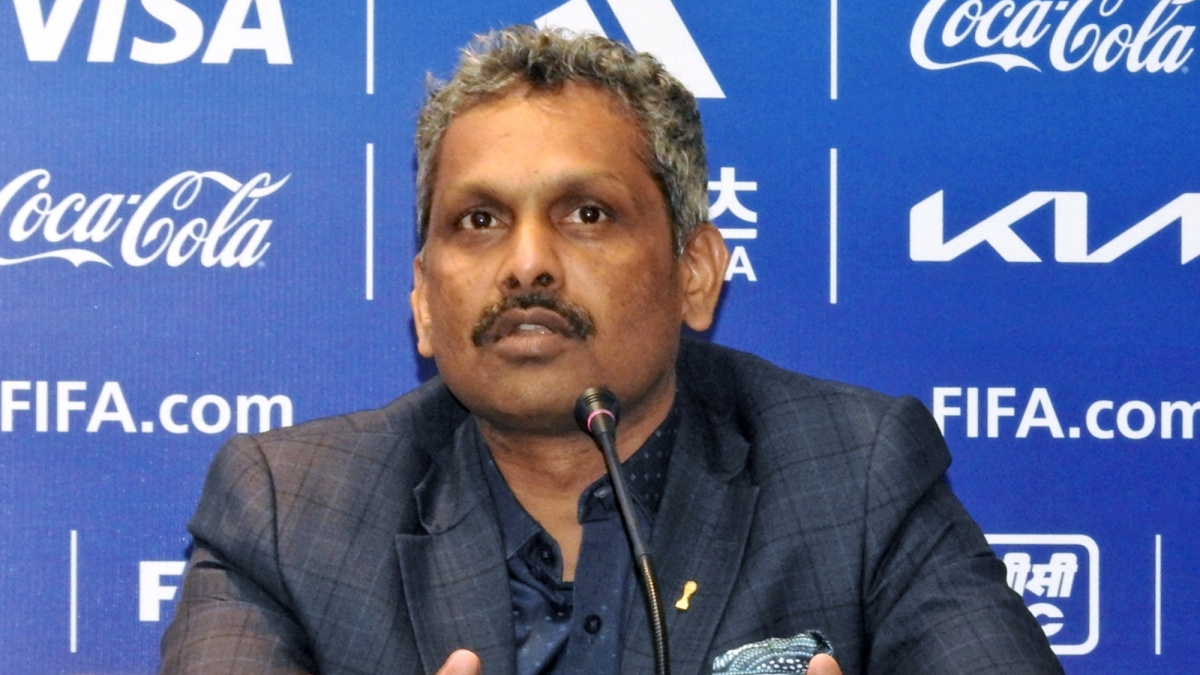
Former All India Football Federation: Former All India Football Federation (AIFF) general secretary Shaji Prabhakaran has urged India to transform its periodic FIFA World Cup enthusiasm into a sustained movement for football development, saying the country must celebrate the sport throughout the year rather than only during the multinational event every four years.
In a column ahead of the FIFA World Cup 2026, Prabhakaran said football becomes hugely popular in India every four years, but much of that interest disappears once the tournament ends.
“Football must become part of everyday life in India rather than a four-year carnival. When football is celebrated 365 days a year, it becomes part of the country’s cultural bloodstream. That is the level of adoption India should seek,” Prabhakaran wrote in a column on his blog.
He noted that during the World Cup, television channels, newspapers, and social media are full of discussions about football, with many people asking why India has not yet qualified for the tournament.
However, he said the same level of attention is often missing when the Indian national team plays important matches or when Indian football faces challenges.
“FIFA World Cup motivates India to envision a new era for football in the country. Newspapers dedicate entire pages to the event, social media is flooded with analysis and fandom, television channels transform football into a national craze, and prominent figures from various sectors suddenly become enthusiastic commentators on the sport. During this period, India seems like one of the world’s great football cultures,” the former AIFF secretary wrote.
“However, beneath this spectacle lies an uncomfortable truth: much of this enthusiasm is temporary. The same individuals who fervently question why India is not part of the World Cup often remain silent when the Indian national team plays important matches, when clubs face survival challenges, and when the sport requires consistent, grassroots support,” he added.
The 54-year-old pointed to the qualification of smaller nations such as Cape Verde and Curaçao for the expanded 48-team FIFA World Cup 2026 as evidence that football success is determined more by planning and governance than by population size.
“Football success is not solely determined by population size. Vision, structure, coaching, scouting, development pathways, administrative competence, governance standards, and long-term execution are far more significant. Smaller nations can qualify by aligning talent with strategy and planning. India cannot continue using size as a comfort while ignoring the systems that transform passion into performance,” he added.
According to Prabhakaran, India should prioritise grassroots development, coaching pathways, stable competitions, sports science and transparent governance, while making qualification for major youth tournaments a key national objective.
“If India wants to compete seriously on the global stage in the coming decade, then qualifying consistently for major youth tournaments must become a national objective,” he wrote.
“The men’s and women’s Under-17 national teams should be developed with the specific ambition of reaching future FIFA U-17 World Cups,” he added.
Concluding his column, Prabhakaran urged Indians to use the FIFA World Cup 2026 as a starting point for building a stronger football culture in the country.
“Celebrate the FIFA World Cup! Support Indian Football! Enjoy the event starting on 11th June, celebrate the sport, and find a purpose in backing Indian football,” he concluded.
Article Source: IANS