
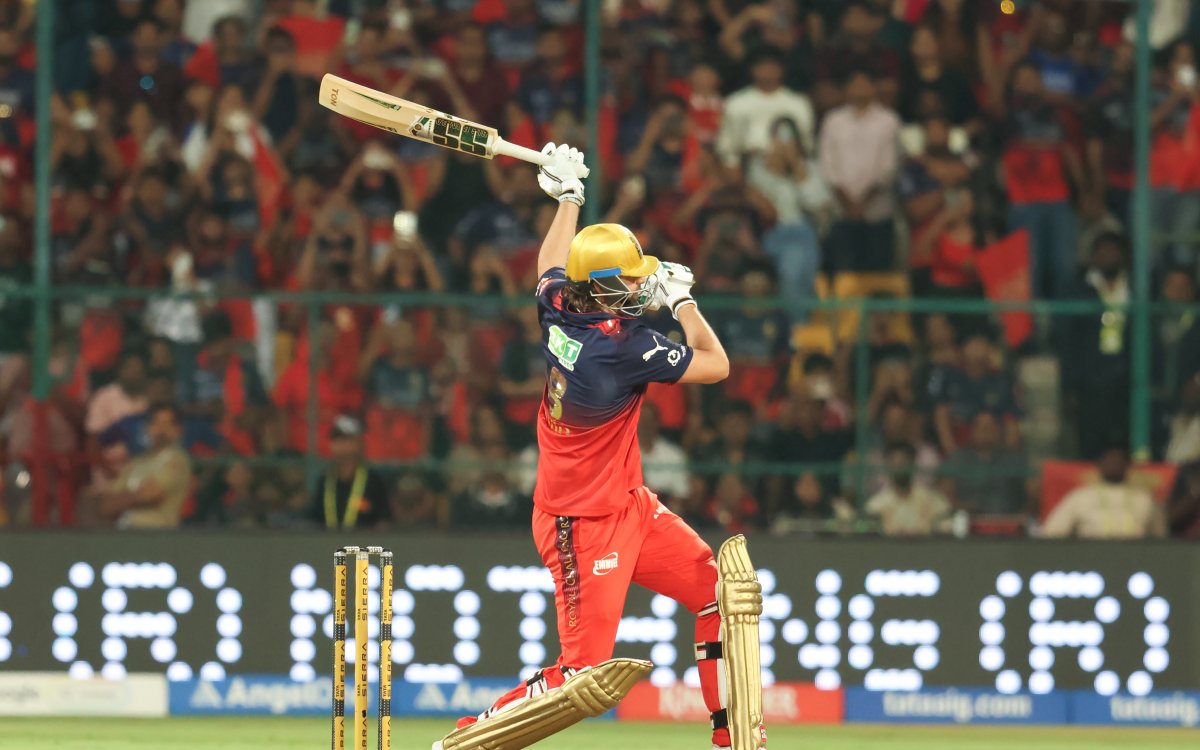
Royal Challengers Bengaluru: Royal Challengers Bengaluru (RCB) batting coach and mentor Dinesh Karthik believes the ongoing Indian Premier League (IPL) 2026 season has redefined the boundaries of T20 cricket, where towering scores are a routine affair and teams fearlessly hunting them down, adding that he finds the batting approach ‘inhuman’ at times.Flat pitches, short boundaries, and the impact player rule have meant that teams are routinely chasing down 200-plus targets. On Saturday, Punjab Kings set a new record for chases in IPL by hunting down 265 against Delhi Capitals at the Arun Jaitley Stadium.
Later, Sunrisers Hyderabad chased down 229 against Rajasthan Royals at the Sawai Mansingh Stadium in Jaipur. “First up, credit to all teams who are chasing down such big totals, and also to the teams that are setting such massive totals. The game has changed; the landscape of T20 cricket is changing every day. You see these scores and think, ‘Wow, it’s just incredible’.
“At times, it’s inhuman the way teams have been batting. Yes, it’s obviously a challenge batting-wise because you’re trying to be so much more aggressive. With the ball, it’s a different challenge – you try to protect as much as you can and try to do your best at it.
“So it’s been wonderful to see how this IPL is actually constantly raising the bar for teams across the world and for the players who are playing because they need to reinvent and obviously make sure that they are moving along with how fast the game is going. So it’s been a privilege to be part of it, and you just sometimes look at it and marvel at how well this game is progressing and to what heights it’s reaching,” said Karthik in the pre-match press conference.
Run-making in power-play has breached the 10 runs per over mark, while dot-ball percentage is below 40 percent, and boundary percentage has gone past 25 – all of which never happened in previous seasons of the IPL. The impact player rule has also meant that a side like PBKS never looked in trouble in the chase and reached 265 with seven balls to spare.
Karthik acknowledged the balance between bat and ball remains a constant debate in the IPL, but insisted the T20 format is in a ‘good place’. “It’s always a debate, isn’t it? When you start scoring a lot of runs, you feel how you equalise it for the bowler and vice versa. I think this format is in a good place.
“There have been some interesting changes made by the fact that you have added reviews to decisions that are being made, you’ve added impact player, etc. But the results have been quite alarming in a positive way.
“I think the world looks at IPL and goes, this is a different brand of cricket altogether because the T10 strong teams are competing against each other and each one of the teams pushing the other to do something very special to win a game of cricket, which is exactly what you want in terms of rivalry, standard, etc.
“I’m very happy with the place that IPL is in and I think in many ways it’s an example of how cricket should be played and for that matter even sports should be played because there are definitely areas where each team is going back to the drawing board and saying this is where we need to improve and they are addressing it at the end of each season and that’s why you see the standards increasing with every passing year,” he elaborated.
Calling 220 ‘the new 180’ in T20s, with IPL 2026 seeing four successful 200-plus chases and its overall run rate being the highest in the history of the competition, Karthik underlined how batting power and innovation have transformed the game. “The new normal – it is a good way to put it. I think the question is a very valid one because obviously the bowlers are challenged, aren’t they? 200-220 scores – teams seem to be getting it, and it almost feels like 220 is the old 180 or something like that, and teams are getting there quite often.
“So, it is a challenging situation for any bowling coach and any bowler, for that matter, because the pitches are obviously quite flat and batters have improved their range of stroke play. Add to that, they have increased their power as well, and some of them are hitting massive sixes.
“So, obviously, as a bowling unit, you need to be very aware of what is happening and how the scores have increased and how you need to be thinking as a bowler. Without revealing too much, I would say so far we are trying our best to do a good job. More variations, why not? That will make the bowling side of things very interesting,” he said.
Saturday was a tough day to be a bowler, and the same story could be there for the rest of the season. Karthik also felt that the changing nature of the pitches will also determine if a particular game will be a run-fest or not.
“First of all, I don’t know if you are asking me a question or scaring me, but definitely it feels like most teams are backing themselves to chase down most totals and that’s a good sign to be fair because that tells you that the batters these days actually are coming in fearlessly to the point where they back themselves to do very different things to what it was done a few years ago.
“So, you have to be open as a batting unit. You don’t want to set any target or challenges for you as a batting unit, but constantly keep making sure the way the batters look at how each inning needs to be is different on each given day, on different pitches. Like in Bengaluru, sometimes we played on pitches which probably went 260-250 pitches, as you saw against DC, we got 180, and it was a good game.
“Against LSG, they got 160, and we had to bat and get there, and we did that. So, it depends on the pitches. On some pitches, like Jaipur yesterday, 230 was scored. DC, here, 260 plus was scored. So, each pitch varies, but in general, you have to say that it is very interesting to see how this game is actually unfolding in each venue and with every given day, depending on which pitch you play, some crazy scores are being met with for sure,” he explained.
He further noted how shot-making has evolved into a power-driven extension of traditional strokes. “People are playing an extension of a normal cricketing shot, so to speak. I remember a few years ago, you said 10 years, I think that’s a good number to have. A lot of these scoops, reverse scoops, all of that were like, ” Oh, how can players play that?
“Now it’s more like, can you just check your drive, and can it go for a six? So I would say people are focusing more on making sure their normal shots that they had have a lot more power added to them. In clearing the boundary, in clearing the ropes, and also they’re becoming very clever in the power play in terms of what positions they get into, probably to play a lot of the boundaries.
“As we see, CSK is batting on a slightly different pitch today. The scores are not that high so far when I last saw them at the end of 10 overs. So with every pitch, every venue, it seems to change. But you have to say, in general, the shot-making has definitely improved, and there’s also a lot of power added.
“Otherwise, you wouldn’t get such consistent scores of 220. The role of an impact player, the psychological impact that it has on a batting unit, knowing that you bat a little deeper than normal, could also be a factor in it.”
On the role of analytics, Karthik credited RCB’s analyst Freddie Wilde for bringing valuable insights. “It is very good that you asked the question about Freddie. Yes, we do use data, and we try to understand the metrics and see how we can obviously use it to our advantage. We definitely try to do a bit of that. In terms of whether the outlook of the team has changed and the way we play as a team, I think it isn’t a good question for you to answer.
“From the inside, it feels like we are making a conscious effort to use these metrics to help our players achieve something special. Last year, we were good enough to beat some good teams and in the end, crossed the line. So, we are making a conscious effort at that.
“So far, the process has been very interesting because you get to understand, two years ago I was playing, and today I am on this side of the fence, and I am thinking, wow, it is so interesting to see so much data and how do you use it to upskill the players, upskill the team in general. So far, I must say the experience for me on a personal note has been very good, and Freddie has been one who is feeding us very valuable information,” he concluded.
Article Source: IANS