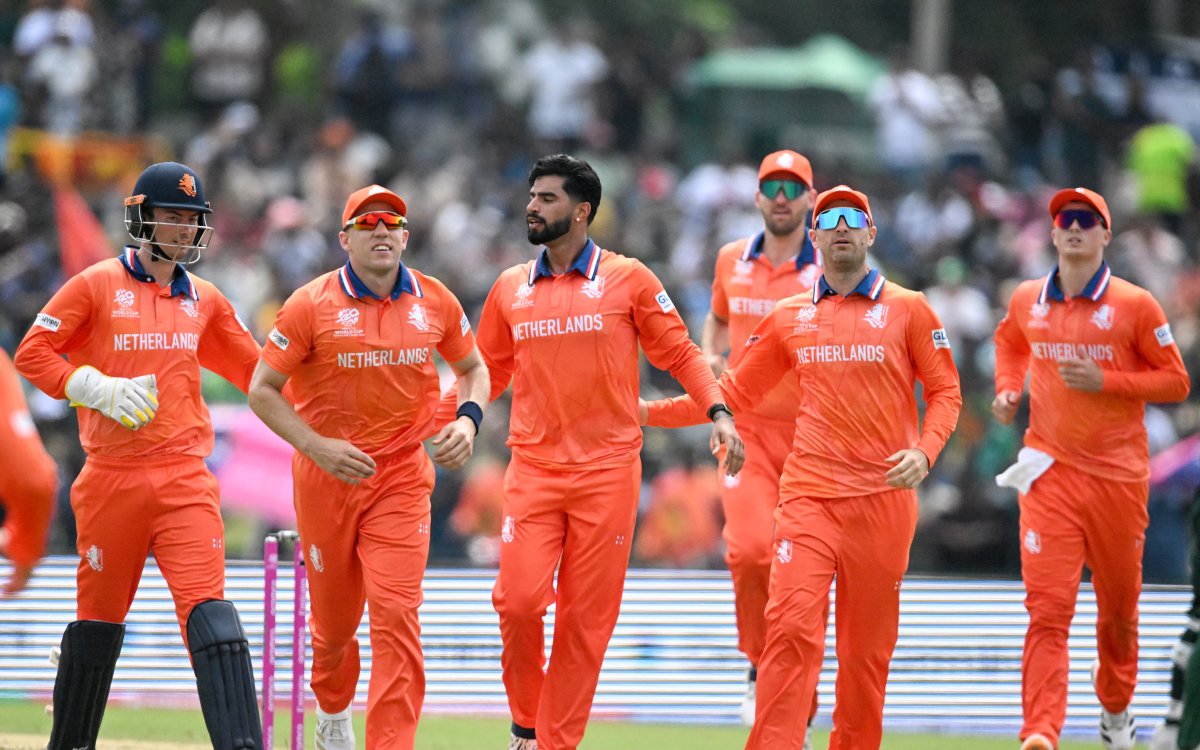
Royal Netherlands Cricket Board: The Netherlands putting up a spirited performance before going down to a three-wicket loss to Pakistan in the 2026 Men’s T20 World Cup opening game in Colombo encapsulated a broader truth about Dutch cricket: punching above their weight while operating with tied hands behind their back.As the team prepared for their Group A clash against Namibia, another country with a thin talent pool who have full-time professional players and recently hosted Men’s U19 World Cup games, at the Arun Jaitley Stadium on Tuesday, the contrast between on-field competitiveness and off-field constraints couldn’t have been starker.
With approximately 5,000-6,000 active cricketers across 60 cricket clubs and a competitive eight-team Topklasse league, the grassroots are flourishing, especially with South Asian origin expats taking up the sport in great numbers.
Yet a funding shortfall of approximately 1.2 million euros – a quarter of the Royal Netherlands Cricket Board’s (KNCB) operating budget forecasted in 2024 along with infrastructure issues and lack of games with big teams outside the World Cups – threatens to derail ambitions just as the talent pool reaches critical mass.
John van Vliet, the Netherlands’ manager and a seasoned observer of Dutch cricket, highlights how far the player base has expanded in recent years. “Just as an example, to put the squad together for this tournament, there was a choice. I’ve got a feeling six years ago, we wouldn’t have a choice of players. Five, probably even six of the guys who made the qualification possible are not here.
“That was, of course, because of the country contracts and they came back in because there are no leagues around the world these days. But at least it gives us something as a certain base,” van Vilet told reporters on Monday.
The depth now available represents a sea change from previous generations. Yet the very existence of that depth highlights ongoing challenges around player availability. “It will happen again this summer when we play the World Cricket League, two matches. Not all of the county guys will be available. Our coach does it always on availability. He doesn’t want to bring the guys into trouble by getting them in.”
“By ICC rules, you can, but it might hurt their careers in their counties or whatever. So he always does it on availability. We could have, for example, during qualification, fly in one or two of the guys for one of the matches, let them fly back into England and probably… well, you weren’t allowed to bring them back again, but he didn’t do it.”
Despite these constraints, progress is evident. “That’s the situation we are in and we know we are in it. But at least, compared to a couple of years ago, the squad has been growing. I’m not saying that if we brought the other guys…I’m not talking about level in strength, but there is a broader squad now to pick from,” he said.
Several Dutch players have county experience, though post-Brexit regulations have complicated pathways. Roelof van der Merwe had a successful stint at Somerset, while Tim Pringle, Bas de Leede, Paul van Meekeren and Colin Ackermann have also featured in county cricket.
“With all the new Brexit and EU rules, it’s difficult for our boys to get an England county contract anyhow because they are seen as a foreigner player. If I be honest, I would pick an Australian above… well, not every Australian, but you know what I mean. It’s hard – if you count the foreign players and you have to take a Dutch player instead of an Indian, Australian or whatever player, it’s hard for them to get in,” he said.
Asked about Test cricket ambitions, van Vilet was blunt about the obstacles. “We need to do a lot to play Test cricket. But we don’t have a stadium, for example. We can build a temporary one, as we did for World League matches versus England. It might be on the horizon, but without glasses, I won’t see that horizon.”
“Let’s be clear. I don’t feel there is, at the moment, real Test ambitions. ODI status, definitely. On top of that, but then we have to get there first and then we might start thinking of that. So every cut in funding is hard for us.”
The financial challenges are multifaceted. A combination of substantially reduced ICC funding and failure to secure anticipated sponsorship, compounded by inflationary pressures and lower-than-expected subsidy from the NOC*NSF (Netherlands Olympic and National Sports Federation), left the KNCB facing the 1.2 million euros shortfall for 2025.
The situation is further complicated by ICC warnings of potential future revenue decrease by 30 percent in 2028 when their media rights contracts come up for renewal. Van Vilet explained how currency fluctuations add another layer of difficulty: “For example, the value of the dollar at the moment, because ICC do all their funding in dollars, makes it hard for us because the Euro is very good to the dollar now. So that means automatically, it’s a drop down in numbers already for this year’s budget.”
The board only secured a title sponsor – Globe Group of Companies – just three days before the T20 World Cup began, even as players are on a nine-month contract. “We were able to find a sponsor in Globe Capital just three days before this tournament starts. So it’s really hard,” said van Vilet.
Infrastructure limitations extend beyond stadiums to training facilities and international exposure. Van Vliet noted that while the Netherlands has developed quality pitches, attracting major nations for warm-up matches remains difficult.
As of now, Netherlands has one major hosting around – the VRA Ground in Amstelveen, which is currently under snow cover. It hosted Super League ODI games against England and West Indies in 2022, with temporary stands erected to have more home fans seated.
“We got a feeling in general, not only India, but all the bigger destinations are visiting England every year. They’re looking for preparation games, warm-up games. We’ve got a few wickets around the Netherlands where they could do preparation games or one or two warm-up games. They still want to do it on English pitches, so we should make that work.”
“For them, it’s easier when you’re based in England for your five-match Test series or whatever, it’s easier just to go up the road to Ireland or Scotland than have to travel back to another outside EU which has visa things as well. So it’s easier to travel around the UK and I know Ireland is not in the UK, but still very close.”
The team’s World Cup preparation reflected these constraints – a certain group of players trained in South Africa, before another group trained in Mumbai and all of them came together in Chennai, before flying to Colombo for the clash against Pakistan.
Management structures also operate on shoestring budgets. “For example, I’m a part-timer as well, so as another manager, only went to Colombo. Our coach, Ryan Cook was doing all the managerial stuff when they were in Chennai. So it’s really combining functions and there’s a lot to do for him also.”
A few Dutch players maintain careers or studies alongside cricket. Fast bowler Saqib Zulfiqar works at ABN Amro, while Bas de Leede and Aryan Dutt are doing studies. Despite funding challenges at the elite level, participation is growing – particularly in unexpected quarters. Crucially, homegrown talent is emerging in 20-25 age group.
“A year or two ago, the federation got a call from a company in Eindhoven which is ASML chip makers. For the first time in our history, which is over 120 years, the company called for ‘please help us laying down a cricket pitch or a cricket field because we got most of our employees from India, Pakistan or Bangladesh asking for playing cricket.’”
“There is a certain number of clubs now in the southern parts of the Netherlands where it was probably one club, and there is about eight clubs now developing there. If you look at our national junior teams – under 11, 13 and all those, I would say at least half of them is filled by expat kids.
“Of course, some of them do come from another origin or played in another country, but they feel very much for playing for Holland because either their parents or their grandparents or whatever. The first thing they do when they touch down in the Netherlands for the first time is go to visit the places where their parents lived.
Public awareness remains modest but is trending upward. “Our national TV station is very much into Winter Olympics these days and they are a huge team. But they are still live streaming our matches in this World Cup which is absolutely unique because I am sure three years ago they wouldn’t have done that while another event was going on. But they are doing it now.
“To be honest, not much in newspapers. But that’s also to be seen. You can blame me if you walk down the street in the Netherlands and ask them, but I think there will be some common knowledge that we are taking part in the World Cup. Probably they won’t know where or when we play. They were streaming only two of the matches from the ODI World Cup and it has grown.
The 2023 ODI World Cup victory over South Africa marked a watershed moment. “It was in our 8 o’clock news for the first time in our history. So not the sport news but the general 8 o’clock news which was huge,” van Vilet said.
“Our football team missed several World Cups. We may miss it for sure in the future. But, well, it’s quite stable at the moment to be able to plan even. I’m not saying we’ve planned the 2027 World Cup but there is a plan leading up to qualification,” concluded van Vilet.
Article Source: IANS